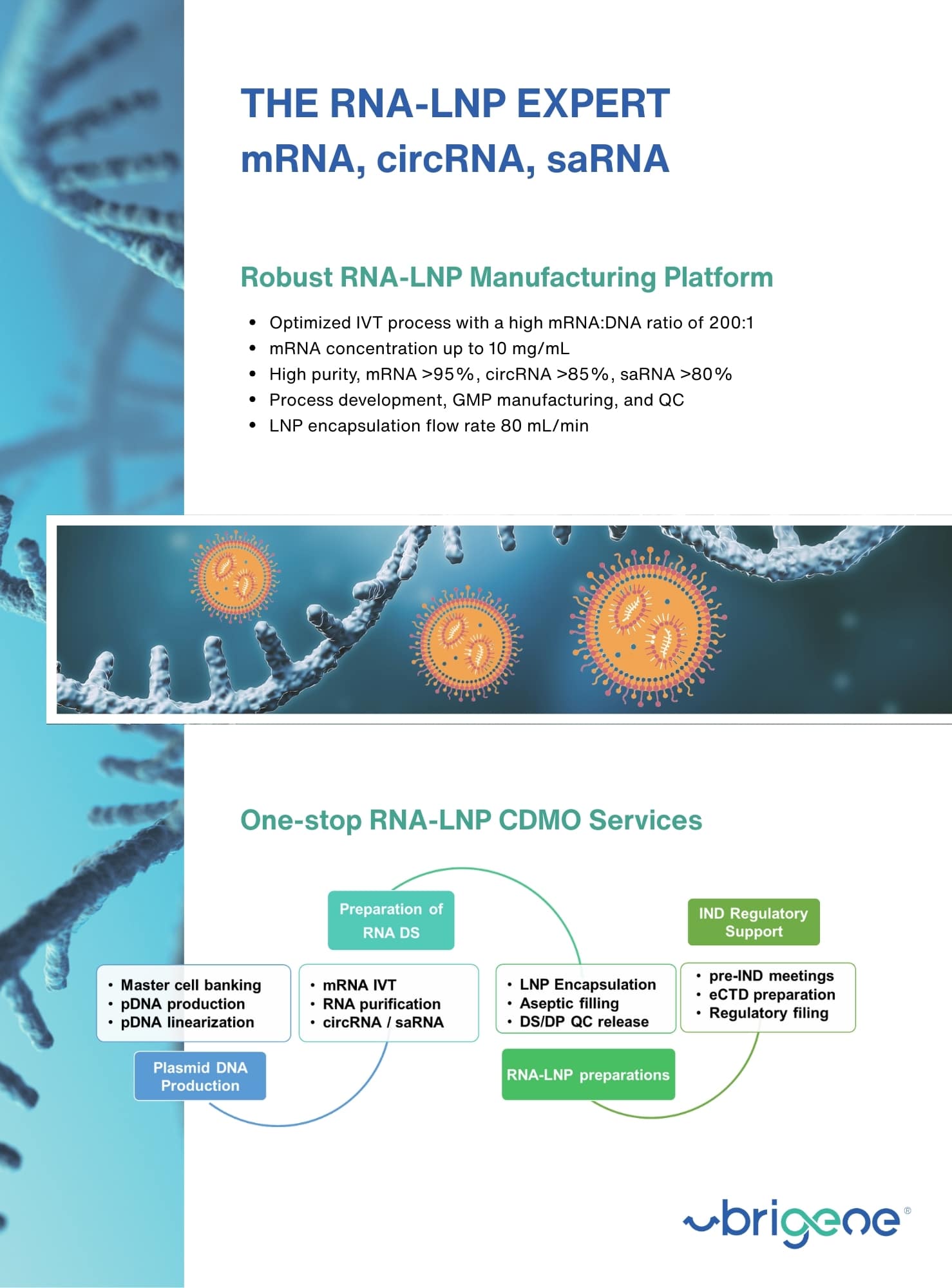
Discover uBriGene’s RNA-LNP manufacturing platform and proprietary microfluidic LNP formulation technology, designed to reduce costs and accelerate timelines for therapeutic developers.

The efficacy and safety of RNA-based therapeutics and vaccines rely on manufacturing high-quality RNA and encapsulating into optimal lipid nanoparticles (LNP). uBriGene provides an end-to-end CMC solution to developers of RNA-based medicines.


| Service | Description | Timeline | Price | |
|---|---|---|---|---|
| mRNA | mRNA Production | Custom mRNA production service for preclinical applications, mg to grams quantity | 2 weeks | Please Inquire |
| mRNA-LNP Production | mRNA production and LNP formulation service for preclinical applications | 2 Weeks | ||
| circRNA | circRNA production | Custom circRNA production service for preclinical applications, mg to grams quantity | 2 Weeks | |
| circRNA-LNP production | circRNA production and LNP formulation service for preclinical applications | 2 Weeks | ||
| saRNA | saRNA Production | Custom saRNA production service for preclinical applications, mg to grams quantity | 2 Weeks | |
| saRNA-LNP Production | saRNA production and LNP formulation service for preclinical applications | 2 Weeks | ||
| sgRNA-IVT | sgRNA Production | Custom sgRNA in vitro transcription service for preclinical applications, mg to grams quantity | 2 Weeks | |
| sgRNA-LNP Production | sgRNA production and LNP formulation service for preclinical applications | 2 Weeks | ||
| GMP Services | GMP RNA / RNA-LNP Manufacturing | GMP RNA, RNA-LNP process development, tech transfer, manufacturing and testing | Varies | |

With our high productive RNA manufacturing platform and RNA-LNP formulation technologies, we can accelerate your RNA therapeutic and vaccine programs.
uBriGene has developed the capability to manufacture mRNA, circular RNA (circRNA), and self-amplifying RNA (saRNA) for gene modification and vaccine therapeutic programs. Below is the generic workflow for mRNA and saRNA-LNP production. circRNA needs an additional circularization step after in vitro transcription. The most used RNA circularization method is the PIE method, in vitro circularization using group I introns.
Our innovative in vitro transcription of single-guide RNA (sgRNA) is a much more scalable and cost-effective process than chemical synthesis. Details about sgRNA-IVT can be found at GMP sgRNA-IVT manufacturing services.

mRNA/saRNA manufacturing workflow diagram
uBriGene has developed a scalable, cost-effective and time-reducing RNA-LNP manufacturing process that is adaptable to various RNA modalities (mRNA, circRNA, saRNA, and sgRNA) and lipid chemistries.
Key steps of our microfluidic RNA-LNP encapsulation technology include high-speed mixing of lipids and RNA solution, tangential flow filtration (TFF) for buffer exchange and RNA-LNP concentration, followed by sterile filtration and final product fill/finish..
Ask the RNA-LNP Expert
Fig. 1. eGFP is highly Expressed in Cells with uBriGene Produced mRNA-LNP

Fig. 2. RNA-LNP formulation screening studies. Eight different LNP formulations (horizontals) have been screened for high GFP expression in different cell lines. GFP mRNA was used for this LNP formulation study. A: Glial cell line, B: Neuronal cell line, C: Macrophage cell line, D: Spermatocyte cell line.

Fig. 3. RNA-LNP formulation screening studies in eight different culture media. GFP mRNA-LNP was used for this study. Horizontals are eight different cell culture media. A: Glial cell line, B: Neuronal cell line, C: Macrophage cell line, D: Spermatocyte cell line.
| mRNA | Circular RNA | |
|---|---|---|
| Format | Linear | Circular |
| 5’ Capping, PolyA tailing? | Yes | No |
| Expression mechanism | 5' cap structure + Kozak translation initiation site | IRES |
| Intracellular stability | Lower (within a week), dependent on capping efficiency and the length of polyA tail | Higher (around two weeks), no need for 5’ cap and polyA structure |
| Coding sequence limitations | Long, dependent on the upper limit of in vitro transcription enzymes | Circularization efficiency decreases as the length increases |
| Production yield | High in vitro transcription yield | High in vitro transcription yield, need additional steps to remove linear RNA |
| Expression intensity | High transient expression intensity, followed by rapid decline | Comparable to mRNA expression with better persistence |
| Immunogenicity | High | Low |
| Applications | Applications requiring rapid expression of proteins | Applications requiring prolonged protein expression |
RNA-LNPs provide a non-viral approach for delivering RNA payloads and can support transient protein expression without requiring genomic integration of the therapeutic RNA sequence. LNPs can also co-deliver multiple RNA payloads, which can be useful for applications such as CRISPR gene editing. The optimal delivery system depends on the target cell, tissue, payload, dosing strategy, and therapeutic mechanism.
Yes. uBriGene can provide commercially available lipids for RNA-LNP formulation development and manufacturing and can also work with client-supplied custom lipids. The team can support formulation process development and technology transfer for client-specific RNA-LNP formulations.
A typical RNA-LNP formulation contains an ionizable lipid, phospholipid, cholesterol, and PEGylated lipid. The identity and ratio of each lipid, along with formulation conditions, can significantly affect particle characteristics, stability, biodistribution, and RNA delivery performance.
Key critical process parameters include lipid identity and ratios, RNA concentration, mixing conditions and flow rate, solvent conditions, tangential flow filtration (TFF) parameters, sterile filtration, and fill/finish conditions. Controlling these variables helps optimize RNA-LNP quality, consistency, stability, and process performance.
uBriGene supports RNA-LNP characterization including particle size and distribution by dynamic light scattering (DLS), RNA concentration and encapsulation efficiency using LC-UV and fluorescence-based methods, surface charge/zeta potential by electrophoretic light scattering (ELS), and lipid analysis using LC-MS. Process-related impurities such as template DNA, genomic DNA, lipids, and dsRNA can be assessed using techniques including capillary electrophoresis (CE), LC-MS, LC-UV, and LIF. Safety testing can include bioburden and endotoxin testing, with the final analytical panel tailored to the RNA modality and development stage.
RNA manufacturing typically involves a multi-enzyme in vitro transcription (IVT) process, and yield and quality can be affected by DNA template quality and purity, template design including the promoter, 5′ and 3′ UTRs and poly(A) tail, ORF characteristics such as hairpins or repetitive sequences, RNA transcript length, modified nucleotides, RNA polymerase, capping strategy, reaction conditions, RNase levels, downstream purification, and final product storage conditions. These parameters may require optimization according to the RNA sequence, manufacturing process, and intended application.
uBriGene reports achieving up to approximately 94% circRNA purity in process-development studies. Actual purity depends on the RNA sequence, circularization efficiency, purification conditions, and analytical methodology.
uBriGene produces circRNA using the PIE (permuted intron-exon) circularization method following in vitro transcription (IVT). Downstream purification is used to remove linear RNA and other process-related impurities. The purification strategy can be optimized according to the circRNA sequence and process requirements.
uBriGene's saRNA process development has achieved approximately 80–90% full-length RNA integrity, depending on the sequence. Because saRNA molecules are substantially larger than conventional mRNA, sequence design, IVT conditions, purification, and handling can affect full-length integrity.
uBriGene uses proprietary microfluidic mixing technology to combine the RNA-containing aqueous phase with lipid components in ethanol. The resulting RNA-LNPs are processed using tangential flow filtration for buffer exchange and concentration, followed by sterile filtration and, where required, aseptic fill/finish.
Self-amplifying RNA (saRNA) is an RNA modality engineered to encode both a therapeutic or antigen-encoding sequence and the machinery required for intracellular RNA amplification. This amplification can potentially support protein expression from a lower initial RNA dose, although performance depends on sequence design, target cells, delivery system, and application.
Key challenges in circRNA manufacturing include achieving efficient circularization, controlling reaction conditions, and removing residual linear RNA from the circularized product. uBriGene produces circRNA using the PIE (permuted intron-exon) circularization method following in vitro transcription, followed by downstream purification to remove linear RNA and other process-related impurities. The company reports achieving circRNA purity above 90% under its process conditions, with actual performance depending on sequence and process conditions.
Different RNA modalities can require different formulation and process conditions because RNA size, structure, concentration, and other molecular characteristics can affect encapsulation and particle properties. uBriGene evaluates formulation and process parameters according to the RNA payload to optimize encapsulation, particle quality, stability, and delivery performance.
uBriGene provides custom RNA production for mRNA, circRNA, self-amplifying RNA (saRNA), and sgRNA. Services can range from preclinical RNA production to GMP RNA and RNA-LNP manufacturing, with support that can include template construction, RNA synthesis, purification, LNP formulation, analytical testing, and fill/finish.
For the listed preclinical RNA production services, uBriGene indicates a typical turnaround time of approximately two weeks. Actual timing depends on the RNA modality, sequence, quantity, purification requirements, and project scope. GMP projects generally require additional development, testing, and release activities.
uBriGene supports custom RNA production from milligram to gram quantities for preclinical applications and provides GMP RNA and RNA-LNP manufacturing for clinical development. Manufacturing scale and final quantity are determined by the RNA modality, sequence, formulation, and project requirements.
Yes. uBriGene provides RNA production services ranging from preclinical research materials to GMP RNA and RNA-LNP manufacturing. An appropriate development and technology-transfer strategy can be established to transition a selected RNA construct and formulation toward GMP production, based on project requirements.
Tap into our mRNA, circRNA, and saRNA manufacturing and LNP formulation expertise, focus your time on discovery research!
Request a Quote