Induced pluripotent stem cells (iPSCs), reprogrammed with integration-free mRNA from FDA-compliant donor cells sourced in the USA, have been fully characterized and released.

iPSC banks were generated in a GMP-compliant cleanroom in accordance with regulatory requirements. Reprogramming was performed using our efficient RNA-LNP kit with donor cells sourced from the USA.

Donor sourced from the USA, fully FDA compliant
Generated using mRNA reprogramming, no genomic footprint
Fully characterized and rigorously tested
Multiple iPSC banks available
| Product Name | Catalog Number | Description | Product Grade | Product Size | Price (Research Grade) |
|---|---|---|---|---|---|
| iPSC-Cells-Banks | IPSC-BANK-SC-R | Single cell-derived iPSC line: Generated using uBriGene’s mRNA-LNP reprogramming mix from fibroblasts. | Research | 1mL/vial | $1,860 |
| IPSC-BANK-SC-G | GMP | 1mL/vial | Please Inquire | ||
| IPSC-BANK-CL-PR | iPSC clonal cell banks: Generated using uBriGene’s mRNA-LNP reprogramming mix from PBMCs. | Research | 1mL/vial | $1,550 | |
| IPSC-BANK-CL-R | iPSC clonal cell banks: Generated using uBriGene’s mRNA-LNP reprogramming mix from fibroblasts. | Research | 1mL/vial | $1,550 | |
| iPSC-Cells-Culture-Media | iPSC-Media | Media for iPSC cell culturing | ☑Research ☑GMP | 500mL/bottle | Please Inquire |
Note: Research use only. Licensing is required for commercial use. View the product's LULL.
iPSC Cell Banks
Sit aliquam elit vitae bibendum lectus blandit dictum. Nisi porta elementum sed diam eleifend pellentesque. Quis aenean quam.
Request a Quote

Extensive iPSC generation and banking experience with access to essential raw materials, including iPSC reprogramming mRNA-LNP mix and CRISPR gene editing tools.
Extensive plasmid production experience
100+ GMP plasmid projects annually
| Donor | Cell Source | Disease | Reprogramming Method | Format | Storage Temperature | Vial Size |
|---|---|---|---|---|---|---|
| Asian, female, 38 | Skin Fibroblasts | Healthy | RNA-LNP | Cryo-preserved | -160oC | 1mL |
Healthy fibroblasts from a U.S. donor were reprogrammed using uBriGene’s RNA-LNP kit. iPSC clones are picked ~2 weeks later, cryopreserved as seed banks at P2–P5, and expanded into MCBs via single-cell cloning for clinical use.
RUO iPSC lines are developed from seed banks and support stem cell research, regenerative medicine, and disease modeling. Gene editing services and products are also available — contact us to learn more.

Fig. 1. RUO iPSC lines and GMP iPSC banks generation diagram using uBriGene’s reprogramming mRNA-LNP cocktail mix.
The iPSC colonies were identified with AP staining on day 18. The results showed that iPSC colonies were positive for AP staining, with reprogramming efficiency reaching as high as 10%.
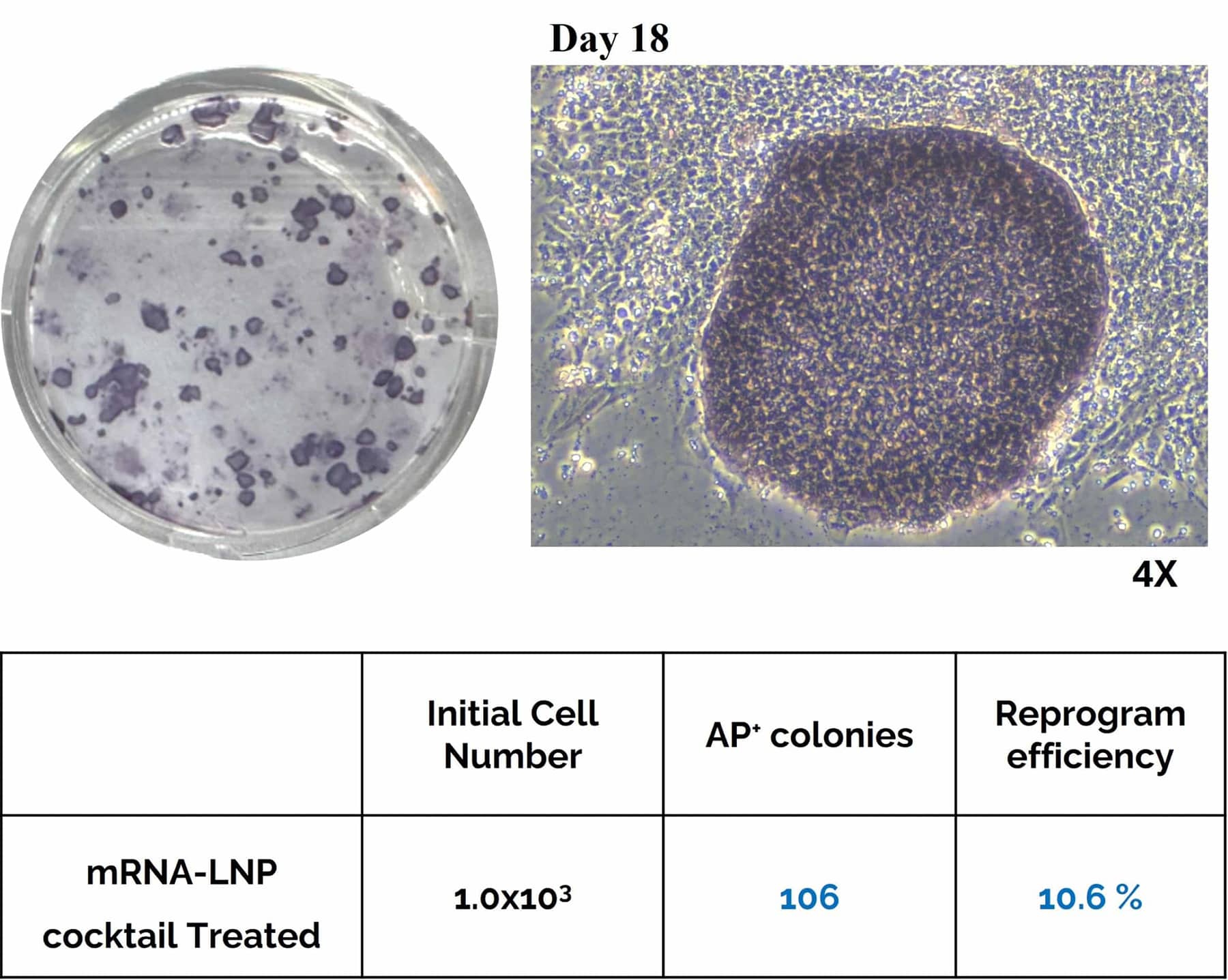
Fig. 2. iPSC identification using Alkaline phosphatase staining after the iPSC reprogramming process with mRNA-LNP cocktail.
Flow cytometry analysis showed that iPSCs cell banks generated by iPSC Reprogramming mRNA-LNP Cocktail express undifferentiated cell markers (SSEA4, TRA-1-81, Sox2, and Nanog).

Fig. 3. Detection of pluripotency identification markers for uBriGene’s iPSC cell bank, including SSEA4, TRA-1-81, Sox2, and Nanog, using flow cytometry.
iPSC cell banks generated using uBriGene’s reprogramming mRNA-LNP cocktail are tested for pluripotency. Embryoid bodies are differentiated from the iPSCs and specific cell lineage cell markers are detected via immunofluorescence staining.

Fig. 4. iPSC cells were differentiated into embryoid bodies to demonstrate the pluripotency of the iPSCs generated using our iPSC reprogramming mRNA-LNP cocktail. Immunostaining was performed for Nestin, MAP2, AFP, and SMA.
Our iPSC master cell banks were rigorously characterized for stemness, pluripotency, genetic stability, safety, and the absence of adventitious viruses.
| Test Item | Method | |
|---|---|---|
| Appearance | Visual observation | |
| Identity | Cell morphology | Microscopic observation |
| Karyotype analysis* | G-banding | |
| STR* | STR | |
| Stemness Markers | SOX-2 | Flow Cytometry |
| Nanog | ||
| Oct4 | ||
| SSEA4 | ||
| TRA1-60-R | ||
| TRA1-81 | ||
| Cell Viability | Cell viability | Trypan Blue/AOPI |
| In Vitro Pluripotency | Trilineage differentiation | Immunofluorescence staining |
| In Vivo Differentiation | Teratoma formation* | Animal inoculation method |
| Safety | Sterility | Culture Method |
| Mycoplasma Testing | ||
| Mycobacterium Testing* | ||
| Adventitious Viruses | Cell morphology observation and hemadsorption test* | Pharmacopoeia method |
| TEM* | ||
| In vitro inoculation and culture method with different cell types* | ||
| Retrovirus examination* | ||
| Inoculation method in animals and chicken embryos* | ||
| Bovine-derived virus detection* | ||
| Human-derived virus detection | ||
| Impurity | Residual antibiotics | ELISA |
Learn about uBriGene’s iPSC banking and reprogramming capabilities.
Unveil uBriGene’s RNA and LNP manufacturing capacities and testing.
Discover CAR-T production process & regulatory guidelines.
Unveil the current manufacturing approaches for LVV and its deployment in cell therapies.
Yes. uBriGene supports GMP iPSC cell bank development and manufacturing for preclinical and clinical development programs. GMP cell banking can include master cell bank establishment, characterization, quality testing, and documentation appropriate to the intended manufacturing and regulatory strategy.
Donor screening and documentation for iPSC cell banking depend on the source material, intended use, and applicable regulatory requirements. uBriGene follows applicable requirements under 21 CFR Part 1271 for donor material procurement and maintains documentation supporting donor eligibility, screening, and traceability. Specific requirements can be defined according to the cell source and development program.
uBriGene’s iPSC cell-bank characterization and release testing can include identity, stemness and pluripotency markers, cell viability, genetic stability, sterility, mycoplasma, adventitious-virus testing, and other cell-bank-specific quality attributes. Pluripotency can be assessed using flow cytometry for markers such as SSEA4, TRA-1-81, SOX2, and NANOG, together with differentiation-based assays as applicable to the cell-bank program.
uBriGene supports the development and manufacture of iPSC cell banks for research, preclinical, and clinical development programs. Depending on the program, cell banking can include master cell banks (MCBs), working cell banks (WCBs), and other qualified cell banks required for downstream iPSC manufacturing.
An iPSC master cell bank (MCB) is a qualified, well-characterized primary bank established as the controlled source for generating downstream working cell banks. A working cell bank (WCB) is derived from the MCB and is typically used to support routine manufacturing while preserving the MCB as the reference source. Establishing both can help provide consistency and traceability across an iPSC manufacturing program.
uBriGene’s RNA-LNP iPSC Reprogramming Kit is a ready-to-use lipid nanoparticle formulation for reprogramming somatic cells into induced pluripotent stem cells (iPSCs). The cocktail delivers RNAs encoding five reprogramming factors and is designed for fibroblast, PBMC, and other somatic-cell reprogramming applications.
The RNA-LNP cocktail delivers reprogramming-factor RNAs into somatic cells, triggering their conversion into induced pluripotent stem cells (iPSCs). Because the reprogramming factors are delivered as RNA, this non-integrating approach does not require DNA delivery or an integrating viral vector, reducing the risk of permanent genomic changes.
The workflow involves repeated RNA-LNP treatments followed by culture, colony formation, selection and expansion, and characterization of the resulting iPSC lines.
RNA-LNP iPSC reprogramming offers several advantages over Sendai-virus reprogramming. The RNA-LNP cocktail avoids gene integration, provides high reprogramming efficiency with low cytotoxicity, and can be delivered directly to cells without transfection reagents or viral manipulation.
It also avoids the additional passaging required for Sendai-virus clearance. Sendai-virus reprogramming may require up to 10 iPSC passages for viral clearance, whereas RNA-LNP-mediated reprogramming does not require additional passaging for viral clearance. This difference can simplify the workflow and reduce time and cost. The comparison is supported by a published study of mRNA-Lipid Nanoparticle-Mediated Reprogramming and Standard Sendai Virus Reprogramming: Generation of iPSCs and iPSC-Derived Cardiomyocytes.
The RNA-LNP iPSC reprogramming process typically takes approximately 15–18 days to reach the selection and expansion stage. iPSC-like cells may appear around Day 11, with typical colonies forming around Day 13. The exact timeline can vary depending on the starting cell type and culture conditions.
Yes. iPSCs generated using uBriGene’s RNA-LNP reprogramming cocktail are characterized for pluripotency. The resulting cells express key pluripotency markers, including SSEA4, TRA-1-81, SOX2, and NANOG, and uBriGene’s iPSC characterization program can include differentiation-based assessment of pluripotency.
Extensive expertise with a track record of successfully releasing over 60 GMP batches of AAV.
iPSC Cell Banks for clinical use
Sit aliquam elit vitae bibendum lectus blandit dictum. Nisi porta elementum sed diam eleifend pellentesque. Quis aenean quam.
Request a Quote