uBriGene’s innovative sgRNA in vitro transcription (IVT sgRNA) delivers high-efficiency, high-fidelity sgRNA with a scalable, cost-effective process for clinic translation.

uBriGene’s proprietary IVT sgRNA production has overcome the challenges of IVT-generated guide RNA, delivering higher gene editing efficiency without cytotoxicity.
The IVT sgRNA method has been optimized for scalability in a GMP environment, resulting in unprecedented cost- and time-savings.


| Service | Description | Scale | Timeline | Price |
|---|---|---|---|---|
| Research Grade IVT sgRNA Production | sgRNA in vitro transcription production services for discovery and preclinical studies | µg to mg | 2-3 Weeks | |
| GMP IVT sgRNA Manufacturing | sgRNA IVT manufacturing meeting GMP requirements | mg to grams | 3-5 Weeks | Request a Quote |


UBriGene has developed a simple, rapid, and scalable IVT-based sgRNA production method that consistently produces IVT sgRNA of exceptional quality, while avoiding the environmental impact of chemical synthesis approaches.
The IVT sgRNA production process is more scalable and cost-effective compared to chemical-synthesis methods.
IVT sgRNA is safer.
No chemical reagents are used in in vitro transcription production of IVT sgRNA
IVT sgRNA is more accurate.
sgRNA-IVT preparation process uses high-quality templates and high-fidelity polymerase, while chemical synthesis of long RNA tends to have base mutations.
IVT sgRNA is more stable.
IVT sgRNA is modified at the 3' end of the sgRNA with an RNA aptamer sequence to enhance its stability.
Higher gene editing efficiency.
Gene editing tests show IVT sgRNA results in higher gene-editing efficiency compared to chemically synthesized sgRNA using RNP complexes with uBriGene’s Cas9 protein.

Gene editing efficiency was tested using IVT sgRNA and chemical-synthesized sgRNA in two separate gene editing projects.
uBriGene offers a comprehensive set of CRISPR gene editing tools for genetic engineering to support your cell and gene therapy programs, sgRNA IVT, Cas proteins, Cas mRNA, and donor DNA.
Our sgRNA is produced using our innovative in vitro transcription method, combined with Cas proteins (as RNP) or Cas mRNA (as LNP) for efficient gene editing. If donor DNA is required, we can also produce more stable closed-end linear double-stranded DNA or AAV vectors containing the donor DNA.
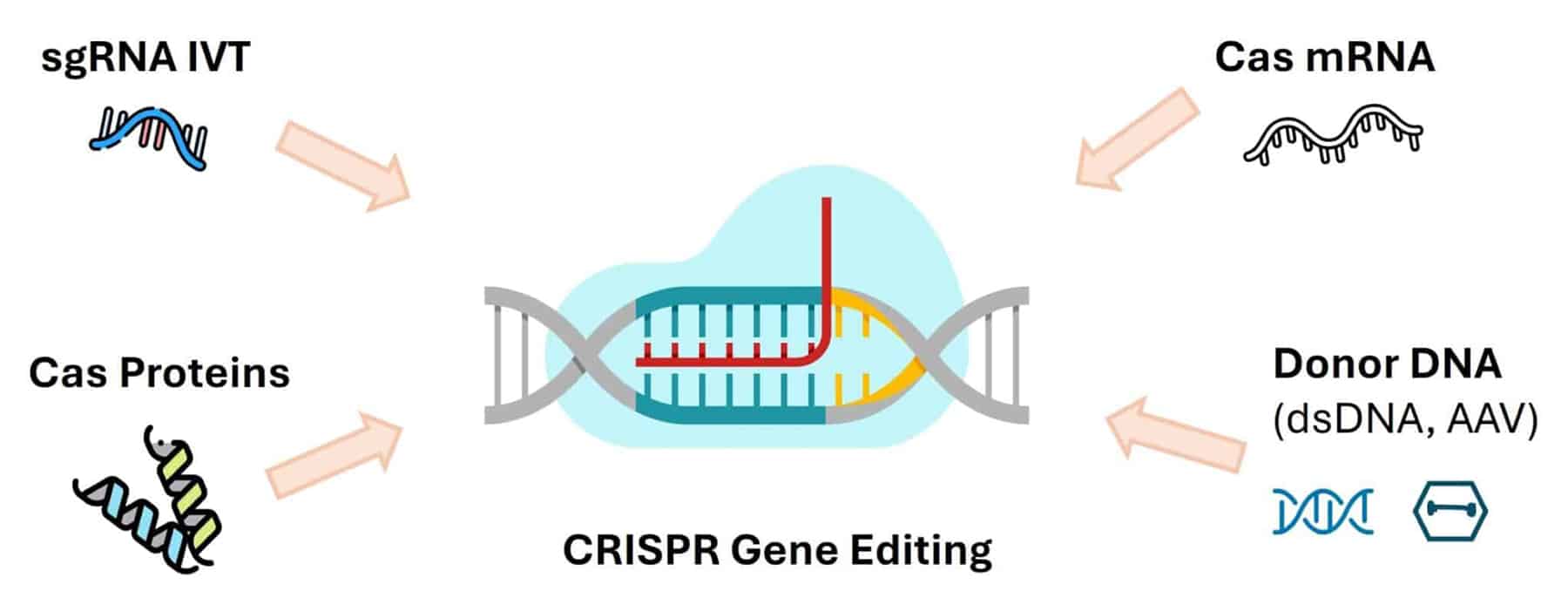
Diagram of CRISPR gene editing tools from uBriGene
Unveil uBriGene’s RNA and LNP manufacturing capacities and testing.
Discover CAR-T production process & regulatory guidelines.
Discover how uBriGene accelerates iPSC-based therapeutics and cell therapies.
Explore RNA drug development fundamentals and the vital role of IVT in manufacturing.
uBriGene can ship IVT sgRNA within 7 business days after order placement, depending on the product specifications and order requirements.
uBriGene can produce IVT sgRNA in quantities ranging from micrograms to grams. The platform supports both research-grade and GMP-grade sgRNA production, with GMP manufacturing following stricter regulatory requirements. The same core IVT production approach is used across grades, with manufacturing controls and documentation adapted to the applicable quality requirements.
Yes, the uBriGene team can assist with the design and manufacturing of reagents needed for KI studies.
Yes, uBriGene experts are available to assist clients with LNP formulation development studies.
We can produce IVT sgRNA of 250 nt and longer. Unlike chemical synthesis, the in vitro transcription method has minimal limitations on the length of the guide RNA.
Yes. uBriGene provides GMP IVT sgRNA manufacturing at mg-to-gram scale, with a scalable production platform designed to support transition from discovery and preclinical development toward clinical manufacturing. GMP production includes stricter manufacturing controls and traceable quality and process documentation.
uBriGene's IVT sgRNA platform consistently produces sgRNA with >98% purity. The manufacturing workflow includes high-fidelity IVT, chromatography-based purification, and sequence confirmation, with quality and process documentation available to support development and GMP manufacturing.
IVT sgRNA provides a scalable manufacturing route for larger quantities and has fewer length limitations than chemical synthesis. uBriGene's IVT process uses high-quality templates and high-fidelity RNA polymerase, while its proprietary 3′ RNA aptamer is designed to enhance sgRNA stability. In uBriGene's reported gene-editing studies, IVT sgRNA achieved higher editing efficiency than chemically synthesized sgRNA under the tested RNP conditions.
uBriGene's IVT sgRNA workflow includes sgRNA design and template preparation, PCR-mediated generation and purification of IVT templates, sequence confirmation, high-fidelity in vitro transcription, and chromatography-based downstream purification. The resulting sgRNA is characterized for quality and purity before use in research or GMP workflows.
uBriGene incorporates a proprietary 3′ RNA aptamer into its IVT sgRNA to enhance cellular stability. The modification is part of the platform's approach to improving the performance of IVT-generated guide RNA and is associated with the platform's reported gene-editing performance.
uBriGene offers research-grade IVT sgRNA production with a typical timeline of 2–3 weeks and GMP IVT sgRNA manufacturing with a typical timeline of 3–5 weeks.
Scalable and cost-effective process
Higher gene editing efficiency