AAV GMP manufacturing platform with access to qualified raw materials that meets the highest regulatory standards for viral vector manufacturing

uBriGene’s talented technical and regulatory teams have extensive experience in the GMP manufacturing and release of adeno associated virus gene therapy.
Our AAV production service offers clients access to qualified 293 suspension cell banks and AAV plasmid (DMFs on file with FDA) to help accelerate the development and production of adeno associated virus. Additionally, uBriGene offers a GMP plasmid manufacturing platform that can produce all AAV helper plasmid required for viral vector manufacturing in an efficient and cost-effective manner.


Automated closed-system technology for manufacturing ensures sterility with functionally closed disposables, minimizes operator errors through pre-programmed steps, and enhances consistency by reducing variability. It also reduces technician hands-on time and lowers production costs.
50+ AAV GMP manufacturing batches
Active FDA DMF #28844 (293XS Cell Banks) and #31873 (293TH Cell Banks)
Successful AAV IND clearance
Off the shelf AAV Plasmid
GMP pHelper & pRC plasmids
Active FDA DMF #28890
Sit aliquam elit vitae bibendum lectus blandit dictum. Nisi porta elementum sed diam eleifend pellentesque. Quis aenean quam.
Ask the AAV Expert
uBriGene has developed 293XS, a proprietary high-yield AAV suspension production cell line. The suspension AAV production platform is serum free and animal component free. The advantage of suspension production cell lines in GMP AAV manufacturing is the scalability, much easier to scale up.
Our fully qualified 293XS cell bank is specifically selected for its exceptional productivity and quality in AAV vector manufacturing, helping to reduce costs for your clinical therapeutic programs.
Serum-free, animal component free
Good Growth at density of 1E7 cells/mL
High AAV productivity, 1E14 vg/L
Activated FDA DMF on file #28844
AAV GMP manufacturing received FDA IND clearance
Scalable AAV production up to 2,000 L
As a leading AAV manufacturing company, uBriGene offers comprehensive AAV CDMO services, forming seamless strategic partnerships with AAV gene therapy developers. Our GMP plasmid production platform enables high-quality plasmid process development and manufacturing as the foundation for AAV GMP manufacturing. We support every step, from AAV proof-of-concept production and process/analytical method development to AAV engineering, GMP manufacturing, QC release testing, and regulatory support.

Diagram of uBriGene’s comprehensive AAV CDMO Services
Request a quoteAt uBriGene, AAV GMP manufacturing platform is based on the transient transfection of AAV packaging plasmids and genes of interest into HEK293 cells. The AAV vector upstream process using our GMP qualified 293 suspension cell banks has been optimized for high titer production and the downstream process involves an AAV purification scheme that maximizes yield of genome containing particles.
 Request a Consultation
uBriGene’s analytical teams can support development of AAV specific analytical methods and routinely releases GMP AAV using well established in-house assays.
| Test Item | Method | |
|---|---|---|
| Identity | Capsid ID | ELISA |
| Target sequence analysis | Sanger sequencing* | |
| General/physical Properties | Appearance | Visual inspection |
| Particle size and distribution analysis | DLS | |
| Chemical Properties | pH | pH measurement |
| Osmolality | freezing-point depression test | |
| Potency | TBD | TBD |
| Contents | Viral particle (VP) titer | ELISA |
| Viral genome (VG) titer | ddPCR | |
| Infectious titer | TCID50 | |
| Purity | Capsid protein purity | SDS-PAGE/CE |
| Empty capsid ratio | AUC | |
| TEM examination* | ||
| Impurity | Residual HCP | ELISA |
| Residual HCD | qPCR | |
| Residual Tween-20 | HPLC | |
| Residual affinity ligand | ELISA | |
| Residual Plasmids | qPCR | |
| Residual endonuclease | ELISA | |
| Residual DNAs, E1A | qPCR | |
| Safety | Endotoxin | USP<85> |
| Replication competent AAV | Culture+qPCR | |
| Sterility | USP<71> | |
| Mycoplasma | USP<63> | |
*Outsourced testing
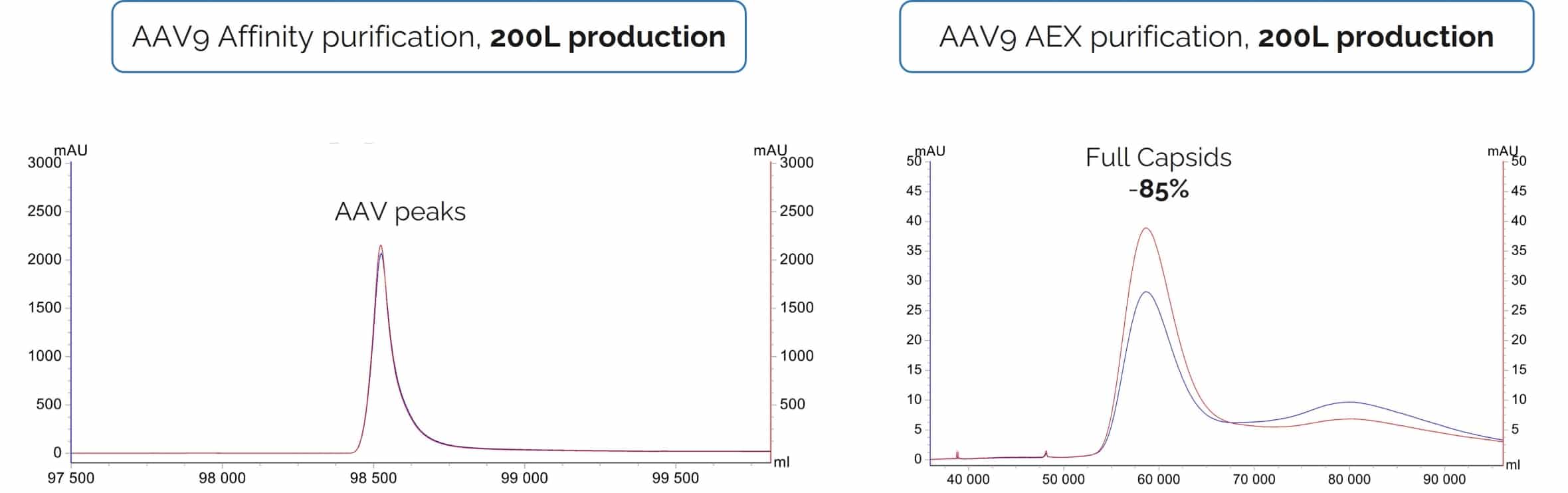
Fig. 1. High-quality GMP AAV9 vector with a high percentage of full capsids produced. A 2-step chromatographic purification process for AAV9 vector was performed following 200L upstream production. High-purity AAV9 vector, including both full and empty capsids, was purified using affinity chromatography. AAV9 vector full capsids were enriched through AEX chromatography, achieving 85% full capsids, as measured by the analytical ultracentrifugation (AUC) method.

Fig. 2. AAV full/empty capsid ratio measured by AUC method.

Discover our AAV manufacturing capabilities, scalable processes, and testing platform.
Discover our GMP plasmid manufacturing process and testing.
Unveil the current manufacturing approaches for LVV and its deployment in cell therapies.
Learn about CAR-T production process & regulatory guidelines.
Yes. uBriGene can use sponsor-provided custom AAV helper or packaging plasmids for GMP manufacturing. Because uBriGene's GMP AAV platform has been optimized around its qualified plasmids, additional process development or optimization may be required when sponsor-supplied plasmids are introduced. uBriGene also provides in-house GMP AAV plasmids supported by FDA DMF #28890.
The estimated timeline from AAV process development through GMP manufacturing is approximately five months, although actual timelines vary with the serotype, scale, process-development requirements, analytical testing, and release requirements. Programs using uBriGene's qualified GMP platform and in-house GMP plasmids may reduce certain technology-transfer and material-preparation activities compared with fully custom programs.
uBriGene supports GMP AAV manufacturing in the United States and APAC, providing regional manufacturing and technology-transfer options for global development programs. The Germantown, Maryland facility maintains active FDA DMF #31266, supporting U.S. regulatory and manufacturing programs.
Yes. uBriGene supports GMP AAV manufacturing at scales from approximately 50L to 2,000L, providing a scalable manufacturing platform for development, clinical, and larger-scale production programs. Final manufacturing scale is determined by the serotype, process, target dose, batch requirements, and development stage.
uBriGene supports in-house AAV analytical method development and routine QC release testing. The analytical panel can include capsid identity, target sequence, particle size, VP and VG titers, infectious titer, capsid purity, full-to-empty capsid ratio, residual host-cell and process-related impurities, endotoxin, replication-competent AAV (rcAAV), sterility, and mycoplasma. Additional testing can be defined according to product and regulatory requirements.
uBriGene provides GMP plasmid production to support AAV manufacturing, with production capability reaching gram-scale quantities. GMP plasmid services can support AAV Rep/Cap and helper plasmids, with manufacturing and QC requirements defined according to the AAV program.
uBriGene has successfully released more than 50 GMP AAV batches, supporting AAV gene therapy programs from process development through clinical GMP manufacturing.
Yes. uBriGene provides both research-grade and GMP-grade AAV production, supporting programs from early-stage research and process development through clinical GMP manufacturing.
AAV is widely used in gene therapy because different capsids can provide different tissue tropisms, and recombinant AAV vectors can support sustained transgene expression in appropriate target tissues. However, AAV programs also require careful consideration of capsid selection, immunogenicity, payload size, manufacturing yield and full-to-empty capsid control.
uBriGene uses analytical ultracentrifugation (AUC) to characterize full, empty, partial, and aggregate AAV capsid populations. Reported process-development and manufacturing results have achieved approximately 70–90% full capsids, depending on the serotype and process. In one documented 200 L AAV9 batch, 85% full capsids were measured by AUC after purification. Actual full-to-empty ratios are process- and serotype-dependent and should not be treated as a guaranteed specification.
AAV manufacturing yield can be affected by the serotype, vector genome and transgene design, plasmid quality and ratios, producer-cell condition and density, transfection efficiency, culture parameters, harvest timing, and downstream recovery. Purification conditions can also affect the balance between total vector yield and product quality attributes such as full-to-empty capsid ratio and residual impurities. uBriGene optimizes upstream and downstream parameters according to each AAV program.
uBriGene uses a 293XS suspension-cell platform for scalable AAV manufacturing. The platform integrates upstream AAV production with downstream purification and in-house analytical and QC capabilities, supporting process development through GMP manufacturing. The current GMP platform supports production at approximately 50 L to 2,000 L.
GMP AAV manufacturing costs vary according to serotype, production scale, process-development requirements, analytical testing, plasmid requirements, and overall manufacturing scope. Custom Rep/Cap plasmids or additional process and analytical development can also affect cost. uBriGene provides project-specific pricing based on the required manufacturing and testing scope.
Key factors include GMP AAV manufacturing experience, production scale, serotype capabilities, GMP plasmid supply, analytical/QC capabilities, batch history, and regulatory documentation.
uBriGene has completed 50+ GMP AAV batches and provides in-house GMP AAV plasmids supported by FDA Drug Master File (DMF) documentation (#28890), along with in-house analytical and QC capabilities. uBriGene has also supported client programs through regulatory submissions and IND clearance.
Extensive expertise with a track record of successfully releasing over 60 GMP batches of AAV.
AAV suspension production cell bank
Streamlined platform-based processes
Sit aliquam elit vitae bibendum lectus blandit dictum. Nisi porta elementum sed diam eleifend pellentesque. Quis aenean quam.
Ask the Expert